
A Memo to Those Celebrating Revolution 250 in Scotch Plains
By Bill Picard
Scotch Plains prepares to mark the 250th anniversary of the signing of the Declaration of Independence with two days of “Revolution 250” events on June 26 and 27. June 26 is also the 249th anniversary of the Battle of Short Hills, a strategic victory for American forces against the British army that outnumbered them 4-to-1. Below is a commemorative letter providing an historic profile of our town since the Township’s 300th anniversary celebration in 1984 .
On October 14, 1984, Scotch Plains celebrated the 300th anniversary of its founding. The day’s events, organized by the town’s Tercentennial Committee, served as the culmination of five months of picnics, parades, and performances. That weekend, residents were asked to fly the American flag and were encouraged to wear badges reading “I’m a Scotch Plains resident,” which had been mailed out by the township.
Over two thousand residents gathered beneath a large tent in the municipal parking lot, eating hamburgers, hot dogs, and Oktoberfest cuisine while country music and the German Knickerbocker Oom-Pah Band played live. Budweiser was served in commemorative Tricentennial mugs, courtesy of the Lion’s Club. Governor Tom Kean addressed the crowd, and the day concluded with carrot and apple crumb birthday cake, a collective rendition of “Happy Birthday” sung to the Township, and the release of thousands of red, white, and blue balloons into the sky.
The event’s planners were as mindful of the future as they were of the past. At 9:30 a.m. the day before, a time capsule was interred in front of Town Hall, intended to be opened in 2026, on the 250th anniversary of the nation’s founding. Between thirty and forty local organizations competed for the opportunity to contribute documents, photographs, and videotapes for preservation within the capsule, each seeking to leave its mark for posterity.
Three days before the capsule was buried, the spokeswoman for the Tercentennial Committee published a commemorative letter. In her “Memo to Those Who Open the Historic Time Capsule,” Maria Sartor profiled the town at 300, tracing a brief history of its founding and the “potpourri of nationalities” that have called it home since, before turning to a portrait of Scotch Plains as it stood in 1984.
In many respects, the Scotch Plains that sealed the capsule is not markedly different from the one that will retrieve it 42 years later. The Stage House Inn is now the Stage House Tavern, and Scotch Hills Golf Course has now had its historic name of Shady Rest Country Club officially restored, but they continue to provide historic and cultural links to the Scoth Plains of the past. Across the street from the capsule, John’s Meat Market, the Highlander, and the Stone House Coin Shop are still as active as the day the capsule was sealed, as are Autumn Harvest and the Swiss Pastry Shoppe around the corner.
And our local calendar still carries the familiar rhythm of community events it had in 1984: Memorial Day and Halloween parades, an Easter Egg Hunt, and since 2015 the annual Patrick’s Downtown Race to Summer 5K, which mirrors local races of Scotch Plains Days past. The East Winds restaurant was named the best Asian restaurant in the state in a NJ Monthly magazine poll at the time, while this year the same publication named Char Steakhouse, in the same location, among the best steakhouses in the state.
Downtown revitalization was a central concern of township leadership in 1984. The newly formed Vitalization Committee, created the year prior to study improvements in the downtown business district, launched a local business survey with a grant from Union County, and conducted studies. In a sublime bit of synchronicity, in May 2026 the Township unveiled a downtown redevelopment plan, an idea first recommended in an “An Improvement Plan” for downtown Scotch Plains, completed by Charles C. Nathanson and Associates on behalf of the Vitalization Committee in December 1984.
Yet despite these surface continuities, the moment also marked a quiet transition from one era to another. That January, one of the town’s few nationally recognized landmarks—the historic School One building on Park Avenue designed by Stanford White—was destroyed by arson. This was the second major arson in four years, following the burning of the 108-year-old Masonic Temple in 1980.
And though it may not have been fully recognized at the time, the long boom in homebuilding that had transformed the town from a small agricultural village into a quiltlike suburb of single-family homes on individual lots was beginning to taper off. Unlike many American suburbs whose growth accelerated in the postwar era of the GI Bill and economic expansion, Scotch Plains’ building boom began during the Depression. Between 1937 and 1947, the population increased 88%, from 4,000 to 7,500, while assessed valuations rose from $4,851,721 to $6,985,310, a 44% increase. Over that decade of hardship and war, nearly 200 homes were constructed in the Chestnut Farms (Crestwood Acres) area, and another 89 in Maple Hill Farms. In 1947 alone, 37 new homes were built in the West Scot Garden neighborhood (Westfield Rd and Mountain Ave), with total new construction approaching $1.5 million for the year.
This pace accelerated in the postwar decades, when between 1950 and 1980 more than 5,300 single-family homes were built. But by 1984 we were almost out of land and inflation was squeezing the middle class; mortgage rates approached 14%, compared to roughly 6.5% today. In the years since, development has increasingly shifted toward higher-density use of our remaining land. Between 1980 and 2025, the town added 1,263 apartments and 593 townhouses.
Some change was chosen; other change was required. Four months after the time capsule was buried, Scotch Plains received its first builder’s remedy lawsuit, entering the Township into the First Round of affordable housing obligations. Earlier this year, the Township was granted approval for its Fourth Round obligations.
The town has also evolved in more gradual, organic ways since the capsule was sealed. In 1984, Scotch Plains had 21,293 residents; today it has an estimated 25,450, an increase of nearly 20%. The school district enrolled 4,034 students then, compared to 5,717 today, a 41% increase. After the postwar Baby Boom peaked in 1970, enrollment declined for 20 consecutive years as students aged out while the first generation of postwar homeowners remained in place, but since 1990 enrollment has risen steadily year over year. Demographers project that by the end of the decade it will reach 6,000 students for the first time since 1978.
Per capita income, $13,840 in 1984, stands at just over $75,000 today, while the average tax bill has risen from $2,764 to $15,818 in 2025. Median home prices on the north side ranged from $90,000–$95,000 in 1984 and $180,000–$185,000 on the south side; today those figures are approximately $740,000 and just under $1.2 million.
One additional change that went “underground” with the capsule was property revaluation itself. In 1984, every property in town had just been reassessed, and it has not been done again until it kicked off this past spring. As a result, the average assessment of a home today still stands at just $128,077—only a few thousand higher than in 1984.
On this 250th anniversary of America, it is worth noting that Scotch Plains predates the country by 92 years. Founded in 1684, nearly a decade before the Salem witch trials, it long served as a key link between the port of Perth Amboy, then the early capital of East Jersey, and New York. It was a critical chokepoint during Washington’s campaigns to prevent British control of New Jersey, and it has sent men to serve in Congress and Drumthwacket. It has produced renowned writers, athletes, and musicians, and offered up its sons as soldiers to serve in every war since the one fought in our own downtown that we commemorate this summer.
We are fortunate to still have institutions that predate the country’s founding: the Baptist Church was established in 1747; the Osborn House (early 1700’s) that took in a misfired cannonball intended for Redcoats marching down Park Avenue; the Frazee House (circa 1720) whose legacy of standing up to maurauding British troops is a potent analogy for the founding of our country as a whole; and of course the Stage House Tavern (1737), already serving customers for 39 years before the Declaration of Independence was even written.
Perhaps most enduringly Scotch Plains remains a place that values, respects, and learns from its past, an identity reflected again in the ceremonial reopening of this time capsule, and in the effort this June 26th and 27th to bring together our community in the spirit of the democratic ideals those we honor this year sought to establish.
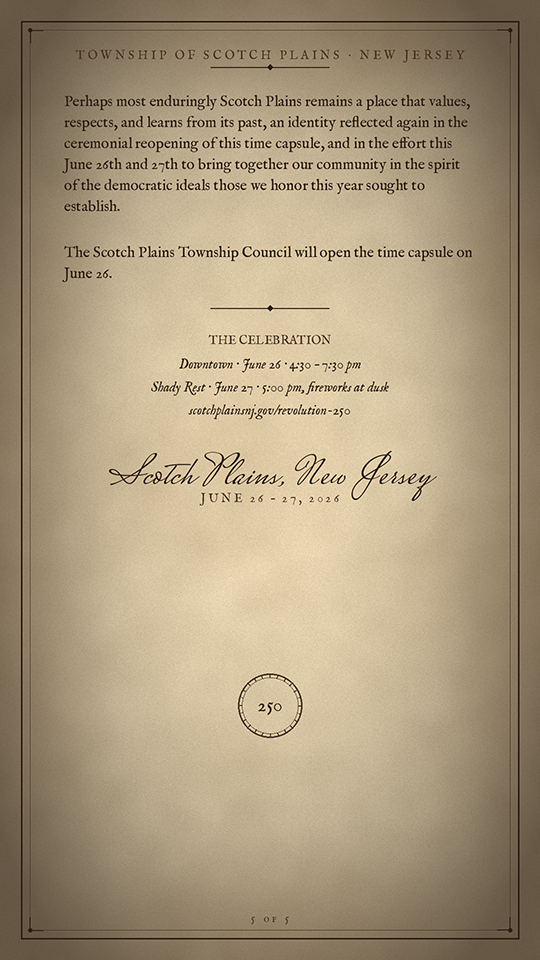
The Scotch Plains Township Council will open the time capsule on June 26. Everyone in town is invited and strongly encouraged to come downtown between 4:30-7:30pm on June 26, and to the Shady Rest on June 27 starting at 5pm for fireworks at dusk, to celebrate America’s 250th birthday. To learn more about the township’s celebrations next week please visit: https://www.scotchplainsnj.gov/index.php/government/revolution-250